Setup
Players
- Ages 5 and up, as the game requires good hand-eye coordination
- 2-16 players in various team formations, for example: 1v1, 2v2, 3v3, 4v4, and so on
Materials
- 4 or 8 quoits per game (2 per player in singles/doubles or 4 per team in triples/foursomes.
- The size and weight of Quoits should be appropriate for players’ age and skill level.
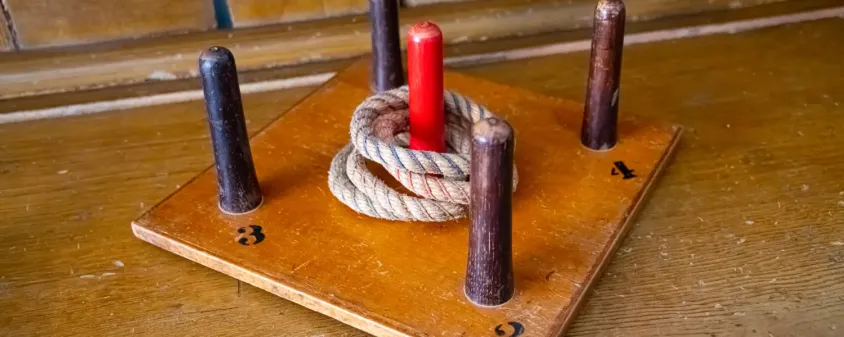
- Two boards (one for each end of the playing field) made of wood, metal, or composite with designated scoring rings and a central pin.
- If you’re interested in the official rules for tournaments or formal play, you can find them here.
Setup Notes
- Find a flat, open area with space for throwing and landing quoits safely. Grass, sand, or gravel are all good surfaces for setting up a game of Quoits.
- Decide on your throw distance – typically 20-30 feet between boards. Mark both ends with cones, tape, or other markers
- Place the two identical target boards facing each other at the marked distance.
- Choose appropriate quoits based on players’ age and skill level, distributed evenly among playing teams.
Quoits Scoring
There are different scoring mechanics depending on the type of Quoits game you have; if your board includes pre-designated scoring for each stake, you will follow that. Otherwise, follow this guide to keeping score:
- The team/player with the quoit closest to the spike after each round scores: Only one player or team will earn points in any given round.
- Your second quoit can earn another point if it’s closer to the spike than your opponents’ quoits.
- Landing a quoit around the stake is called a ringer, and is worth 3 points unless an opponent “tops” it with their ringer, effectively canceling yours.
- Leaners and touchers: A quoit leaning on the top edge of the spike scores 2 points but loses to a ringer. A quoit touching the spike directly (a toucher) also scores 2 points, but two opposing touchers cancel each other out.
- Quoits touching the ground, landing off the board, or hitting another quoit in motion are “dead” and don’t score.
- Reach the agreed-upon score (usually 21 points) first to win.
Objective
In a game of Quoits, the objective is to toss the quoit at the opposing stake, aiming to either land the ring on it or as close as possible to score points.
Gameplay
Quoits is a British ring-tossing game that is rumored to date back all the way to the ancient Greeks – talk about a classic!
Typically played between two individuals or teams, players aim to score points by tossing metal rings toward a stake or collection of stakes fixed in the ground.
The game setup includes two pits about 21 feet apart, each including a stake or multiple stakes. Players take turns throwing four quoits, aiming to land them as close to the stake as possible or achieve a “ringer” by encircling the stake.
Points are awarded based on proximity to the stake, with ringers scoring the highest. If opponents’ throws cancel each other out, no points are awarded for that round.
The game continues until a predetermined score is reached, often 21 or sometimes 25 points. Quoits is a great game for players of different ages, blending tossing skills, strategy, and social interaction for joyous outdoor gatherings.
Endgame
A game of Quoits continues on until one team reaches 21 points, or higher, winning with at least a 2-point lead over the opponent.
Quoits Variations and Alternate Rules
- Deck Quoits is a variant made specifically for cruise ships (or any decks/surfaces that could be damaged with heavier ring material). The rings are made of rope, making it a yacht-safe option to play on board.
- Indoor Quoits: This variation features rubber rings and a board with hooks attached, making it safe to play indoors.
- Square Quoits: A variation where the scoring area is square-shaped instead of round, adding a novel flair to the game.
Quoits Tips & Strategy
Landing a ringer or getting close to the spike takes more than making a toss and hoping for the best. Since you’re throwing at a fixed distance from the target, mastering your aim is key. Practice your throwing style – a smooth, controlled approach works the best; learn to control your speed and trajectory, too. Experiment with various throws to see what lands closest to the target and produces results for you consistently.
- Don’t Forget Overall Winners and Losers: The earlier these bets are placed, the more potential money.
- Time Moves Right: Placing bets at the most strategic times is paramount to winning Camel Up, so make sure to time it right. If you bet early, you could capture more money, but the risk is much higher. If you wait too long, however, the payout is less.
- Pay Attention to Bets: The biggest strategy in Camel Up is paying close attention to the race and making decisions accordingly. Pay attention to how other players are betting — those players could provide insight into the true nature of the race.
FAQs
Is Quoits a fun game?
Quoits is a great pastime for all ages, as long as you like simple yet competitive games that involve throwing an object towards a goalpost.
What other names are Quoits called?
Quoits, one of the oldest games still around, often goes by the name of ring toss and horseshoe.