Setup
Players
- Suitable for all ages, but we do recommend ages 5 and up for the best experience
- Kubb is played in teams of 2
- Between 1-6 players per team
Materials
- 1 King Kubb
- 6 Tossing Batons
- 4 Corner Stakes
- 10 Blocks
- The rulebook: you can refer to these Kubb rules for gameplay
Setup Notes
- Kubb is played on a rectangular pitch about 16 feet long by 26 feet wide (or 8 meters by 5 meters).
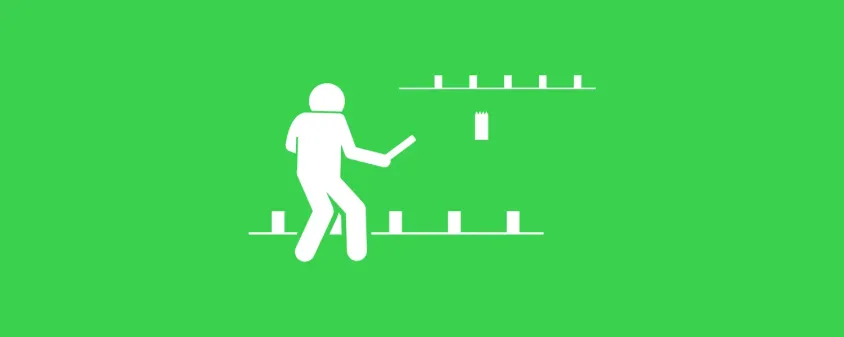
- Set up 5 kubb blocks on each baseline (short sides) of the pitch between the corner stakes.
- Place the king block in the center of the pitch.
- Divide the pitch into two halves, one for each team.
Kubb Rules
- Kubb doesn’t have scoring. Instead, there is a specific order in which blocks have to be knocked over
- When throwing, you must always toss underhand, no helicopter throws allowed
- You have to topple all the opponent’s field kubbs before going for the baseline kubbs
- If baseline kubbs are knocked over before all the field kubbs, they will be put back up where they fell
- After knocking over all the other kubbs, you may try to knock over the King
- If the King is knocked over before the other kubbs, the opposing team wins
Objective
In a game of Kubb, players aim to knock over as many of the opponent’s Kubb blocks as possible, finally knocking over the King pin to win.
Gameplay
Kubb, a classic Swedish lawn game is a fun pastime for gatherings with friends and family. What’s more, it’s thought to have Viking origins!
After you’ve set up the game on the lawn or outdoor area you’re playing in, you’ll make your first throw to determine who goes first. Teams take turns on tossing their dowels, and whoever gets theirs closest to the King without knocking it over, goes first.
In Kubb, the first team starts by grabbing all 6 batons and aiming for base kubbs on their opponents’ side. Each toss throws one baton underhand, with a vertical spin like a propeller – no helicopter throws allowed! In solo games, you throw all 6 yourself, but in teams, share the fun and distribute the throws evenly.
Every round, the winning team collects any knocked-down kubbs from their side. They then throw these kubbs across the centerline to their opponent’s territory. Once the opponent stands them up, the winning team gets to throw all 6 batons again, trying to knock down both the newly placed kubbs and the remaining base kubbs. It’s important to remember that although each team starts with 5 kubbs, the number on each side can change throughout the game as some are knocked down and thrown around the field.
Once a team has knocked over all field kubbs from their opponent’s side, they may go for baseline kubbs. Finally, they may aim for the king to win the round. If they knock over all kubbs in a turn and have batons left over, they can go for the king for the winning throw!
You can play multiple rounds of kubbs, marking the winner each round.
Endgame
A game of Kubb comes to an end once a team has knocked over all of their opponent’s kubb blocks and successively knocked over the king.
Example / Demonstration
Here’s an example of Kubb gameplay with two teams.
- Team 1 starts by throwing their six batons at the opposing team’s kubbs.
- Team 1 successfully knocks down two of Team 2’s kubbs.
- Team 1 proceeds to stand up the knocked down kubbs within their own half as field kubbs.
- Team 2 throws their six batons with the hope of knocking down Team 1’s field kubbs.
- Team 2 knocks down three of Team 1’s field kubbs.
- Team 2 then proceeds to throw their batons at the kubb closest to Team 1’s baseline.
- Team 2 successfully knocks down the king’s guard kubb, opening up a path to the king.
- Team 2 attempts to overthrow the king with their remaining batons.
- Team 2 knocks over the king, winning the game.
Kubb Variations and Alternate Rules
- Stake Height Rules: Some variations involve changing the height of the stake, and altering the difficulty level.
- Quoits: An alternative to horseshoes, quoits involve throwing a flat metal ring instead of a horseshoe.
- Indoor Horseshoes: A variation adapted for indoor play, using rubber or plastic horseshoe-shaped objects in a smaller space.
Kubb Tips & Strategy
Winning Kubb requires strategic thinking. In the early stages of the game, you should prioritize knocking down multiple field kubbs clustered together to maximize baton efficiency. Focus on field kubbs closer to the king to limit your opponent’s throwing area. When placing returned kubbs, consider proximity to the centerline, as you’re able to target them more easily. Conserve batons early by aiming for multiple knockdowns per throw. In team settings, effective communication and shared throwing duties are the key to victory.
FAQs
Is Kubb suitable for children?
Kubb is a family game, but you do need coordination and aim so children under five may struggle.
What do you need to play Kubb?
You’ll need a Kubb set, including one King Kubb, 6 tossing batons, 4 corner stakes, and 10 blocks.
How do you win a game of Kubb?
The team that knocks over all opponent’s kubbs in the correct order, followed by toppling the King pin wins the game of Kubb.