Setup
Players
- Ideally 4-12 players, formed in two teams.
- Ages 14 and up for the best game time.
Materials
- Wavelength Official Board Game
- Dial: A large plastic dial with two arrows; this tracks the clue giver and guesser’s positions on the spectrum.
- Guessing Piece: A token the guesser uses to indicate their estimated position on the spectrum.
- Heads Tokens: A token for each team to track which team is guessing.
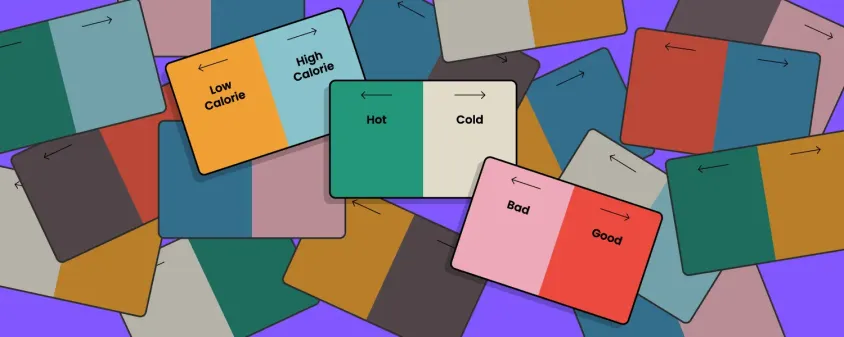
- Spectrum Cards: Double-sided cards with various spectrums (e.g., Hot & Cold).
- Rulebook for the game setup, gameplay, and scoring. You can also refer to this Wavelength rulebook PDF.
Additional Setup Notes
- Place the large plastic dial in the center of the table, make sure that both arrows are pointing at the neutral “0” position.
- Place the guesser’s piece: Set the small token, i.e. the guesser’s piece next to the dial’s “0” on the spectrum track.
- Choose teams if playing with more than 4 players.
- Decide who will be the first clue giver.
- Shuffle the deck of spectrum cards.
- Draw a spectrum card: The clue giver draws the top card from the deck without revealing it to anyone. This card will determine the two opposite concepts they need to uncover with their clue.
Objective
The objective of Wavelength depends on whether you’re playing solo or in teams. As the individual guesser, you’re trying to place your guessing piece on the spectrum correctly using your intuition, reasoning, and the clue you’re given by the clue giver. If you’re playing as a team, your objective is to guide the guesser as close as possible to the correct location on the spectrum.
Gameplay
Wavelength is a social guessing game where teams or individuals try to read each other’s minds.
Each round begins as follows:
- The team’s designated Psychic spins the wheel to randomize the target’s location but won’t show it to others. They should always open the screen completely so others can’t guess the target location.
- The Psychic draws a wavelength card without revealing it to anyone, and gives a clue between the two concepts on the card.
- The Psychic closes the screen completely and turns the box to face their team, so they can interact with the device.
- After the Psychic has delivered the clue, they won’t speak at all, and must keep an expressionless face.
If a Psychic ever gives away the target location after giving their clue, either verbally or nonverbally, it’s up to everyone playing to decide whether to penalize the team. We tend to just let the Psychic give a new clue with a new card and target location, but we’re generous that way.
Moving Into the Team Phase
Let the mind-reading begin! In the Team Phase, the rest of the team tries to turn the dial to the center of the target area. Players are free to converse as they please in this moment of the game. Once the team agrees where to turn the dial, they’ll inform their opponent.
Next Up: Left and Right Phase
After the Psychic’s team has locked in their dial position, the other team gets to guess if the center of the target is to the left or right of the dial. The opposing team will then lock in their guess by placing the marker in either the LEFT or RIGHT position next to the wavelength card.
Moving On: The Scoring Phase and the Reveal!
Once both teams have finalized their guesses, it’s time for the most titillating moment of the game as the Psychic will finally reveal the target by opening the screen. Their team scores points if the dial is within the colored target area. If the dial is between two results, the Psychic’s team always scores the higher one.
The opposing team scores a single point if they nailed the left/right dial position. If the Psychic’s team guessed perfectly (the 4 point wedge), the other team would walk away with 0.
Players will now move their scoring marker by the respective amounts scored during the game. The rounds repeat until a team gets to 10 points and wins the game.
Gameplay Example
Let’s walk through a typical gameplay with two teams of three players.
- Team A’s psychic draws a card with “Hot & Cold” as the spectrum. The secret concepts are “Volcano” and “Ice Cube.”
- The psychic mentions “Lava Lamp.” Team B wonders: is it hinting at temperature (hotter than lava, cooler than lamp) or texture (molten like lava, see-through like lamp)?
- Team B debates, suggesting “Warm Glow” as a safer clue for the guesser. The psychic approves with a finger gesture indicating yes.
- Team B’s guesser moves the piece towards the “warm” side of the spectrum, aiming for “Hot Toddy.”
- The psychic shakes their head ever so slightly, hinting they’re closer to the “hot” end. Team B huddles again, feeling they went too far in their guess.
- The guesser hesitates and moves the piece back towards “Lava Lamp”.
- Team B cheers on as the guesser lands on “Lava Lamp.” Team B earns a point and the roles swap.
Tips & Strategy
The clue giver should craft a clever and relevant clue that bridges the gap between the two contrasting concepts, while remaining within an acceptable range of ambiguity. The team also needs to offer supportive feedback and interpretations of the clue to help the guesser refine their estimate.
FAQs
How many people can play Wavelength?
You can play with up to 12 players, the game is best played in two teams.
How many clues can you give in Wavelength?
While technically unlimited, the Psychic should aim to articulate a single, well-formulated clue.
How long does Wavelength take to play?
On average, the gameplay lasts 45-60 minutes.
Affiliate Disclaimer
We may earn a commision through links on this page.