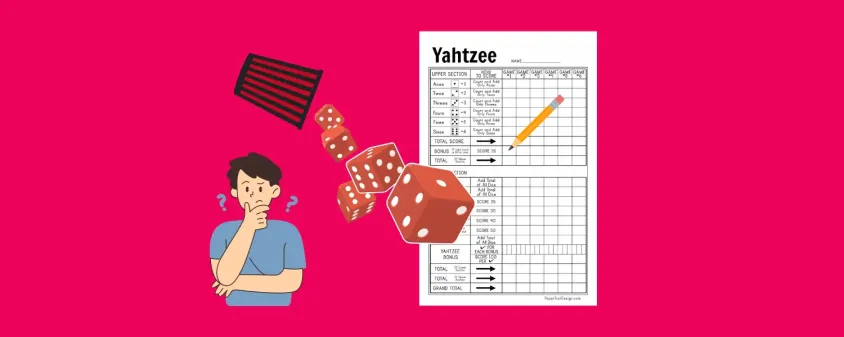
Rules and Scoring
A game of Yahtzee is an instant game night classic loved by players of all ages. If you’re feeling stuck in a Yahtzee rut, this is the one article you need to read for an all-encompassing guide to turning the luck of the dice into a calculated victory.
Yahtzee is more than just a dice-rolling good time. Understanding the intricacies of scoring, reading the dice, and knowing when to strategize is elemental to winning the game. This guide on Yahtzee strategy delves into the tactical depths of Yahtzee, offering insights that will elevate your game beyond mere luck.
Here’s what we’ll cover so you can master optimal Yahtzee strategy:
- Scoring categories, their point values, and how to make informed choices about where to place your rolls.
- Risk and reward: understanding when to go all-in for high-scoring combos and when to play it safe for guaranteed points.
- Insider tips and advanced tactics to outmaneuver your opponents and claim the coveted Yahtzee victory.
And remember, Yahtzee is not just a game for real-life fun; you can also play it online with friends or even solo.
Understanding the Scorecard: Upper vs. Lower Section in Yahtzee
Conquering Yahtzee requires navigating the nuances of its scorecard: two distinct sections offering different scoring opportunities. Let’s break down each section, providing an overview of their scoring options and strategic considerations.
The Upper Section
This section rewards straightforward scoring. Simply sum the values of all dice with the same face (Ones, Twos, etc.).
While seemingly basic, the upper section holds strategic weight. Here is the breakdown of the upper section scoring and strategy:
- Ones, Twos, Threes, etc.: Sum the value of all dice with the same face (e.g., 3 Fives = 15 points).
- Aim for the Upper Section Bonus: Score at least 63 points here to earn a hefty 35-point bonus, setting you on a strong footing.
- Prioritize high-scoring dice: Focus on Fours, Fives, and Sixes for substantial point gains.
- Don’t ignore low values: Ones and Twos can still contribute, especially if you’re close to the bonus.
The Lower Section
Known for its complexity, you’ll earn points for specific dice combinations. Let’s take a look at the options:
- Three of a Kind: Sum all dice if 3 have the same value (e.g., 3 Threes = 9 points).
- Four of a Kind: Sum all dice if 4 have the same value (e.g., 4 Sixes = 24 points).
- Full House: 25 points for 3 of a kind + a pair (e.g., 3 Fours + 2 Fives).
- Small Straight: 30 points for a sequence of 4 consecutive numbers (e.g., 2-3-4-5).
- Large Straight: 40 points for a sequence of all 5 dice (e.g., 1-2-3-4-5).
- Yahtzee: 50 points for rolling 5 of the same value (e.g., 5 Twos).
- Chance: Sum all 5 dice (use when no other category fits).
Yahtzee Strategy: Beginning of Gameplay
How do you master a Yahtzee-start strategy? Here are some ways to secure the coveted upper section bonus, score a high-chance roll, or even roll that coveted Yahtzee right out of the gate in early rolls:
Bonus
Focus on Fours, Fives, and Sixes
These high-value dice offer the best chance to reach the 63-point threshold for the Upper Section Bonus. Keep them all on your first roll, even if it means sacrificing other categories.
Don’t Neglect Twos and Threes
While seemingly small, they can still contribute significantly. If you roll several of them with other promising dice, consider keeping them for the bonus.
Remember, Flexibility is Key
If the dice gods aren’t blessing you with high values, shift gears. If you see the potential for three-of-a-kind or even a straight, adapt your strategy to take advantage of those opportunities.
Chance
Prioritize High Overall Values
Chance provides flexibility but use it wisely. Consider keeping dice that don’t fit established categories but offer high overall values (e.g., two Fours and two Fives).
Think Triples!
Aim for three of the same dice, as they’ll automatically give you a decent score (18 for threes, 24 for fours, etc.). Remember, even doubles can be valuable if you can add them to an existing triple on your next roll.
Go for Broke (Sometimes):
If your other categories are already filled or unlikely to be completed, consider using Chance for a Hail Mary roll. You might unexpectedly land a Full House or even a high-scoring combination.
Yahtzee
Leave the Box Open:
This might seem obvious, but resist the urge to fill the Yahtzee category early. By waiting, you maximize the chance of using it later for a high-scoring, lower-section combination.
Be Picky:
Don’t settle for Yahtzee unless it fits your approach. If you roll it early and can still score highly in another category, consider using it there instead.
Manage Expectations:
Rolling Yahtzee early on doesn’t typically happen, so don’t build your entire strategy around it. Be prepared to adapt and capitalize on other scoring opportunities if the dice don’t align for the ultimate jackpot.
Yahtzee Worst Case Scenario Recovery Strategies
Sometimes things don’t quite roll out as planned; here are useful tips and strategies to recover quickly in a game of Yahtzee.
Low score rolls
Small Scores as a Way Out
Don’t underestimate the power of small scores. Keep dice for ones and twos if they contribute meaningfully to their categories. Remember, even small gains can inch you closer to the upper section bonus.
Take a Chance
If traditional categories seem out of reach, consider chance. Aim for triples or a full house for a solid score.
Strategize for Smaller Combinations:
Analyze remaining dice and future rolls. Can you create any smaller combinations (three-of-a-kind, pairs) to set yourself up for future success?
High score combination fails
Adapt and Reassess
Don’t get hung up on lost scores. Evaluate your remaining dice and scoring options objectively. Can you salvage parts of your failed plan for other categories?
Prioritize Remaining High-Scorers
Focus on categories with the highest potential point return, even if they weren’t your initial plan. Consider four-of-a-kind, full house, or straights if the dice allow.
Be Flexible
Be willing to shift gears entirely if necessary. Sometimes, the best way to recover is to embrace new possibilities presented by the dice.
Bad roll near the end of the game
Keep Calm and Recalibrate
Stay even-keeled and analyze your options rationally. Panicking leads to poor choices.
Maximize What’s Left
Even with limited options, prioritize the category with the highest potential return. Every point matters at this stage.
Think Creatively
Consider unconventional tactics, such as using chance strategically to complete a full house or create a smaller combination that fits another category.
Yahtzee: A Game of Luck and Probability
Looking to nerd out over Yahtzee’s probability of rolling a certain score? Here are the odds for each combination.
Numbers (Ones, Twos, Threes, etc):
- Probability (1st Roll): 1/6
- Probability (2nd Roll): 5/36
- Probability (3rd Roll): 25/216
Three-of-a-Kind:
- Probability (1st Roll): 25/216
- Probability (2nd Roll): 125/1296
- Probability (3rd Roll): 625/7776
Four-of-a-Kind:
- Probability (1st Roll): 5/1296
- Probability (2nd Roll): 65/7776
- Probability (3rd Roll): 325/38880
Full House:
- Probability (1st Roll): 5/108
- Probability (2nd Roll): 35/7776
- Probability (3rd Roll): 175/38880
Small Straight:
- Probability (1st Roll): 15/864
- Probability (2nd Roll): 25/7776
- Probability (3rd Roll): 125/38880
Large Straight:
- Probability (1st Roll): 1/1296
- Probability (2nd Roll): 5/7776
- Probability (3rd Roll): 25/38880
Yahtzee:
- Probability (1st Roll): 1/6 * 1/6 * 1/6 * 1/6 * 1/6 = 1/7776
- Probability (2nd Roll): 5/6 * (5/6)^4 * 1/6 = 5/7776
- Probability (3rd Roll): 5/6 * (5/6)^4 * 5/6 * 1/6 = 25/38880
Quick Tips to Win
How to win Yahtzee every time you play? While there are no guarantees in a roll of dice, here’s how you’ll maximize your chances:
- Prioritize the Upper Section Bonus: It’s a guaranteed 35 points, setting you on a strong footing.
- Keep Yahtzee open: This game-changer could appear at any moment.
- Don’t underestimate low-scoring categories: Every point matters!
- Be flexible: Adapt your strategy based on the dice and scorecard possibilities.
FAQs
Which boxes should I check first on opening rolls?
Prioritize high-value dice (Fours, Fives, Sixes) for the upper section bonus and Yahtzee potential, keeping flexibility for three-of-a-kind or straights if the opportunity arises.
How Risky Should I Be On My Third Roll?
Risk depends on your scorecard, remaining dice, and tolerance for risk: high potential reward (Straights, four-of-a-kind) justifies risk if close, but prioritize guaranteed points near the end.
What is a really good Yahtzee score?
Anything above 300 is typically considered excellent, with 350+ being exceptional.
What is a bad score in Yahtzee?
Scoring in the 100s or even lower might be considered bad during a competitive game with experienced players.